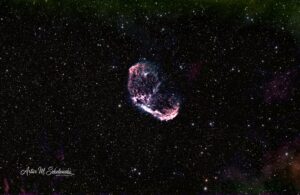
 NGC 6888, widely known as the Crescent Nebula (and catalogued as Caldwell 27 or Sharpless 105), is a cosmic bubble and emission nebula located in the constellation Cygnus. It is positioned roughly 5,000 light-years away from Earth and is famous for its intricate, brain-like filaments and glowing cosmic shells.
The Crescent Nebula is a “Wolf-Rayet bubble”. A Wolf-Rayet bubble is a massive, glowing cosmic structure created by supersonic stellar winds colliding with space debris. It is a specific type of interstellar wind nebula wrapped around a hyper-hot, highly evolved star called a Wolf-Rayet (WR) star.
A Wolf-Rayet bubble is born from a violent, two-stage evolutionary process of a star at least 20 times more massive than our Sun. This evolution looks like this:
Massive Star ⇒ Red Supergiant sheds gas ⇒ Wolf-Rayet Wind Slams Gas ⇒ Glowing Bubble
NGC6888 is entirely powered and illuminated by a central, hyper-massive star named WR 136 (HD 192163). The cosmic structure is the result of a violent, two-part stellar evolution described above:
1. The Red Giant Phase: Around 250,000 to 400,000 years ago, WR 136 became a red giant and gently shed its outer layers of gas into space at a relatively slow speed.
2. The Wolf-Rayet Collision: As the star evolved into a super-hot Wolf-Rayet star, it began emitting fiercely fast stellar winds moving at speeds up to 2,000 to 3,000 km/s. This rapid wind slammed directly into the slower, older red giant gas shell.
This immense collision generated two shock waves. An outward-moving shock wave ionises the gas, causing the hydrogen filaments to glow a brilliant red (and oxygen to glow blue-green). Meanwhile, an inward-moving shock wave compresses and heats the interior stellar gas to millions of degrees, forcing it to emit high-energy X-rays. Because WR 136 is burning through its remaining fuel at an unsustainable rate, astronomers predict it will explode as a spectacular supernova within the next 100,000 years.
Because NGC 6888 is relatively faint, visual observers usually require a UHC (Ultra High Contrast) or OIII (Oxygen III) filter paired with a telescope (80 mm or larger) to track its crescent shape distinctly.
Astrophotographers heavily favour narrowband filters (specifically Hα and OIII). Capturing the outer oxygen envelope creates a striking blue-green “shroud” or bubble structure that completely encloses the red hydrogen core.
My picture was shot using the Luminance + RGB filters. Because it was shot in early July, when the nights are very short and daytime temperatures were very high, and their changes through the night caused frequent refocusing, I didn’t have time to make frames with the narrowband filters.
More Stories
M39 star cluster
Sh2-129 Squid Nebula
NGC281 Pacman