
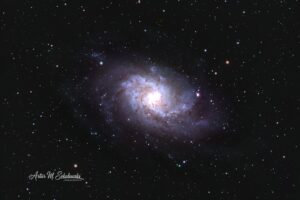
 Despite its relatively modest size, Messier 33 is one of the most active star-forming galaxies in the Local Group. It is popularly known as the Triangulum Galaxy because it lies in the small northern constellation of Triangulum. M33 is a prominent spiral galaxy located approximately 3 million light-years from Earth. It is a neighbour to our own galaxy and can even be spotted with the naked eye under one condition: exceptionally dark, clear skies.
Measuring roughly 60,000 light-years across, M33 is about half the size of the Milky Way. It ranks as the third-largest member of the Local Group of galaxies, trailing behind the Andromeda Galaxy (M31) and our Milky Way. Astrometric data suggest that M33 is gravitationally bound as a satellite companion to the larger Andromeda Galaxy, toward which it is currently moving.
Although Italian astronomer Giovanni Battista Hodierna may have observed it before 1654, French astronomer Charles Messier independently discovered and formally catalogued the galaxy on 25–26 August 1764. He published it as the 33rd entry in his famous Catalogue of Nebulae and Star Clusters.
According to data from the NASA Hubble Space Telescope, M33 forms new stars at roughly ten times the rate of the Andromeda Galaxy. Because its spiral arms show little structural disruption, scientists believe this rapid star birth is occurring naturally rather than being triggered by a violent galactic collision. The galaxy contains massive clouds of ionised gas where new stars ignite. The most famous of these is NGC 604, an emission nebula spanning nearly 1,500 light-years across. It is one of the largest known stellar nurseries in the entire Local Group, dwarfed only by the Tarantula Nebula in the Large Magellanic Cloud.
Although it lacks a supermassive black hole at its core, M33 hosts M33 X-7, the largest known stellar-mass black hole. Weighing roughly 15.7 solar masses, it is part of an eclipsing binary system. It orbits a massive companion star every 3.45 days, slowly draining its partner’s gas and blasting out intense X-ray radiation.
Astronomers have discovered a massive “bridge” of neutral hydrogen gas linking M33 directly to the larger Andromeda Galaxy (M31). This gas stream is strong evidence of past tidal interactions between the two galaxies. Within this area lies an enigmatic structure known as “Keenan’s Ring”. It is a giant, optically dark ring of hydrogen clouds. It provides strong evidence of the gravitational interaction playing out in our Local Group.
Although some astronomers categorise it as a dwarf spiral galaxy, M33 is massive enough to have its own companion. The Pisces Dwarf Galaxy (also known as LGS 3) orbits it; it is a tiny, faint irregular galaxy on the Local Group’s outer fringes.
The final image was created from 302 individual exposures, comprising:
60 × 60-second luminance frames,
70 × 120-second red frames,
72 × 120-second green frames,
70 × 120-second blue frames, and
30 × 300-second OIII frames.
Together, these exposures yielded a total integration time of 35,040 seconds, or approximately 10 hours 30 minutes of gathered light.
60 × 60-second luminance frames,
70 × 120-second red frames,
72 × 120-second green frames,
70 × 120-second blue frames, and
30 × 300-second OIII frames.
Together, these exposures yielded a total integration time of 35,040 seconds, or approximately 10 hours 30 minutes of gathered light.

More Stories
NGC 7380 The Wizard Nebula
M39 star cluster
Sh2-129 Squid Nebula