
If you’ve ever dived into the weeds of deep-sky imaging software, you’ve probably run into the term PSF, or Point Spread Function. It sounds academic, but it’s actually a pretty straightforward concept.
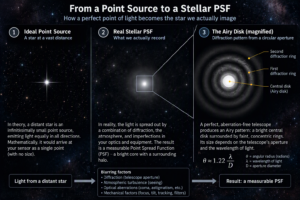 Think of a star. Because it’s light-years away, its physical disk is completely unresolvable by amateur gear. Mathematically, that light should hit your camera sensor as a single, infinitely small pixel. In the real world, though, physics gets in the way. By the time that beam of light fights its way through the atmosphere, passes through your telescope glass, clears out your filters, and finally lands on your sensor, it spreads out. What should be a perfect point becomes a blurry little blob or diffraction pattern. The PSF is simply the mathematical description of exactly how that light got smeared.
What actually causes the blur?
Three big factors ruin our perfectly pinpoint stars:
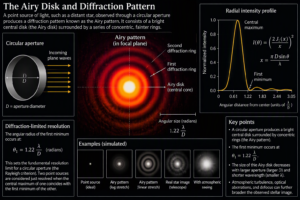 1. Diffraction – As light waves squeeze through your telescope’s circular aperture, they bend and interfere with each other. This naturally creates a bright central core surrounded by faint, concentric rings—the classic Airy Disk.
2. The Atmosphere – This is the big enemy for ground-based imagers. Thermal currents, wind, and atmospheric turbulence scatter the incoming wavefronts, bloating our stars.
3. Optical & Mechanical Imperfections – Everything from slight astigmatism or coma in your optics to a slight temperature drift pulling your rig out of focus will further distort the shape of the light.
How software grades your stars
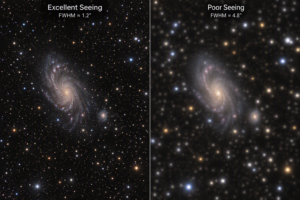 When you load your subframes into tools like PixInsight or ASTAP, the software measures the PSF of your stars using a couple of key metrics to judge your image quality:
• FWHM (Full Width at Half Maximum): This measures the width of a star’s light profile at exactly 50% of its peak brightness, usually calculated in pixels or arcseconds. Lower numbers mean tighter, sharper stars, telling you that your seeing, tracking, and focus were spot on.
• Eccentricity: This measures how far a star’s profile departs from a perfect circle. A perfectly round star has an eccentricity of 0.0. As stars become elongated or distorted into ovals, the eccentricity value increases toward 1.0. High eccentricity values immediately flag issues like tracking errors, poor polar alignment, differential flexure, or corner aberrations like coma.
• Amplitude and Background: This calculates the peak brightness of the star against the local background sky, which is essential if you’re doing variable star photometry.
Gaussian vs. Moffat Profiles
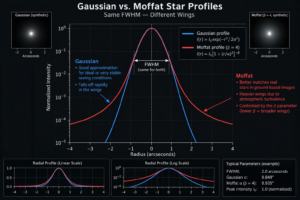 To do this, stacking software fits a mathematical curve to the star’s light distribution. It usually chooses between two models. A Gaussian profile is a standard bell curve. It’s great for modelling a star’s tight, bright core under incredibly stable seeing conditions.
However, Moffat profiles are usually much better for ground-based setups. A Moffat curve does a far superior job of calculating the “wings” and faint halos around stars caused by our turbulent atmosphere.
Why should you care?
Understanding your PSF isn’t just academic; it directly improves your final images. For starters, monitoring FWHM in real time is the absolute best way to nail pinpoint focus, since the lowest FWHM value equals optimal focus.
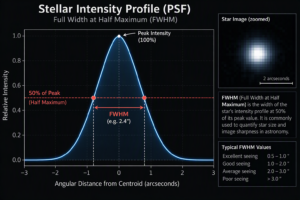 During post-processing, advanced sharpening tools rely entirely on PSF modelling. If a deconvolution algorithm knows exactly how your specific optics and local atmosphere blurred the light, it can mathematically reverse that damage—pulling hidden details out of faint nebulae and galaxies. Finally, stacking software uses these metrics to automatically cull the herd, tossing out bloated, trailed frames so only your absolute best data makes it into the final master integration.
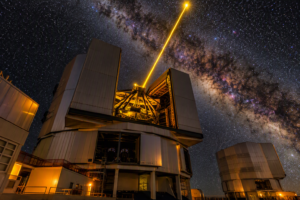
Professional observatories take this a step further. Instead of fixing it in software later, they measure the shifting PSF of a guide star thousands of times a second, using lasers and flexible, deformable mirrors to cancel out atmospheric turbulence in mid-air.

More Stories
Refractor vs Reflector Telescope: Which Is Best for Beginners and Astrophotography?
Dithering – is it really important?
NGC 7380 The Wizard Nebula