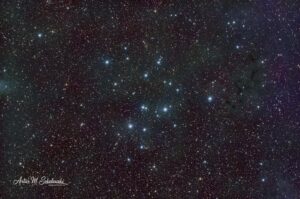
Messier 39 (also designated M39 or NGC 7092) is a large, loosely bound open star cluster located in the northern constellation of Cygnus.
It is a sparse, loose open cluster about 1,010 light-years from Earth. It is estimated to be between 270 and 300 million years old, making its stars relatively young compared to our Sun. It contains roughly 30 to 50 member stars. The brightest members are hot, main-sequence stars of spectral types A and B. At least six of the 15 brightest components are known binary star systems. Its absolute magnitude is -2.5, matching an overall luminosity of about 830 suns. While many stargazers see an equilateral triangle, several astronomical circles formally nickname it the Pyramid Cluster. The alignment of its brightest stars creates a distinct three-dimensional illusion of a pyramid against the flat backdrop of space.
A detailed chemical analysis of M39 published by researchers on Phys.org found that the cluster has a solar-like metallicity with a few unusual elemental anomalies. Its stars are unusually overabundant in heavy neutron-capture elements—especially Barium and Sulfur—while showing a lower-than-average abundance of Sodium.
M39 shines at a relatively bright visual magnitude of 4.6 to 5.5. It spans roughly 29 to 32 arcminutes across, about the same size as a full Moon in the night sky. Under pristine, dark-sky conditions, it can be glimpsed with the naked eye as a faint, fuzzy patch. In binoculars or small telescopes at low magnification, it reveals a distinct equilateral triangular shape with bright stars marking its corners. Because it sits directly in the galactic plane of the Milky Way, its bright member stars contrast beautifully against a dense, rich field of faint background stars. M39 is located in the northern sky, making it easily visible to observers in the Northern Hemisphere, particularly during summer and early autumn. You can navigate to it by finding Deneb (Alpha Cygni), the brightest star in Cygnus. M39 sits about 9 degrees east-northeast of Deneb and 2 degrees south of the star Pi Cygni.
The French astronomer Charles Messier documented and added the cluster as the 39th entry in his famous catalogue in 1764 to ensure comet hunters wouldn’t mistake it for a new comet. Guillaume Le Gentil first discovered it in 1749, and it may have even been recorded as a “comet-like object” by Aristotle as early as 325 BC.
I shot this image in mid-August, with frames taken using LRGB and Ha filters.
It is a sparse, loose open cluster about 1,010 light-years from Earth. It is estimated to be between 270 and 300 million years old, making its stars relatively young compared to our Sun. It contains roughly 30 to 50 member stars. The brightest members are hot, main-sequence stars of spectral types A and B. At least six of the 15 brightest components are known binary star systems. Its absolute magnitude is -2.5, matching an overall luminosity of about 830 suns. While many stargazers see an equilateral triangle, several astronomical circles formally nickname it the Pyramid Cluster. The alignment of its brightest stars creates a distinct three-dimensional illusion of a pyramid against the flat backdrop of space.
A detailed chemical analysis of M39 published by researchers on Phys.org found that the cluster has a solar-like metallicity with a few unusual elemental anomalies. Its stars are unusually overabundant in heavy neutron-capture elements—especially Barium and Sulfur—while showing a lower-than-average abundance of Sodium.
M39 shines at a relatively bright visual magnitude of 4.6 to 5.5. It spans roughly 29 to 32 arcminutes across, about the same size as a full Moon in the night sky. Under pristine, dark-sky conditions, it can be glimpsed with the naked eye as a faint, fuzzy patch. In binoculars or small telescopes at low magnification, it reveals a distinct equilateral triangular shape with bright stars marking its corners. Because it sits directly in the galactic plane of the Milky Way, its bright member stars contrast beautifully against a dense, rich field of faint background stars. M39 is located in the northern sky, making it easily visible to observers in the Northern Hemisphere, particularly during summer and early autumn. You can navigate to it by finding Deneb (Alpha Cygni), the brightest star in Cygnus. M39 sits about 9 degrees east-northeast of Deneb and 2 degrees south of the star Pi Cygni.
The French astronomer Charles Messier documented and added the cluster as the 39th entry in his famous catalogue in 1764 to ensure comet hunters wouldn’t mistake it for a new comet. Guillaume Le Gentil first discovered it in 1749, and it may have even been recorded as a “comet-like object” by Aristotle as early as 325 BC.
I shot this image in mid-August, with frames taken using LRGB and Ha filters.
More Stories
Sh2-129 Squid Nebula
NGC281 Pacman
NGC 6888 Crescent Nebula