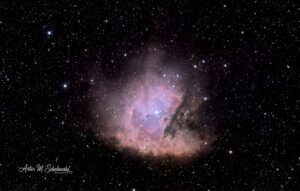
 NGC 281, popularly known as the Pacman Nebula, is a vibrant H II emission nebula and active cosmic nursery located roughly 9,200 to 9,500 light-years away from Earth. Positioned in the northern constellation of Cassiopeia, it resides within the Perseus Spiral Arm of the Milky Way. It owes its famous nickname to its distinct appearance in optical images, where a prominent, wedge-shaped silhouette of dark dust carves into the glowing gas, perfectly mimicking the iconic 1980s video game character.
NGC 281 is far more than an optical illusion; it is a complex, multi-layered environment driven by intense stellar forces. At the physical core of the nebula lies IC 1590, a young open cluster of hot, massive stars born from the nebula’s gas. The cluster’s brightest member is HD 5005 (also known as the multiple star system B 1), a powerful O-type supergiant. This star floods the region with extreme ultraviolet radiation, ionising the surrounding hydrogen gas and causing it to glow with its signature red and orange hues. Visible as dark, ultra-dense knots of dust and molecular gas, silhouetted against the glowing background. These dense regions (first theorised as star-forming sites by Bart Bok in the 1940s) act as incubators where gravity pulls matter together to forge a brand-new generation of solar systems.
The fierce stellar winds and radiation pressure blasting outward from the core stars constantly erode the inner cloud walls.
Strikingly, NGC 281 sits nearly 1,000 light-years above the plane of the Milky Way. This unusual location gives astronomers a remarkably clear, crisp view of massive star formation, free from the thick interstellar dust fields that normally obscure things closer to the galactic disk.
The nebula was first discovered in August 1883 by the pioneering American astronomer Edward Emerson Barnard. Using the technology of the time, he aptly recorded it as “a large faint nebula, very diffuse”.While it looks deceptively dark in the optical “mouth” section due to light-blocking dust, modern space telescopes observing in different wavelengths reveal a different story. For instance, NASA’s Spitzer Space Telescope in the infrared shows that the dark dust lanes actually glow fiercely with thermal heat. Combined with X-ray data from the Chandra X-ray Observatory, astronomers can peek directly inside the cloud to map the exact locations of hidden, newborn stars. For backyard astronomers, NGC 281 is an excellent autumn target in the Northern Hemisphere. It responds incredibly well to narrow-band light filters (specifically H-alpha and OIII), which isolate the glowing gas emissions from surrounding light pollution.
Astrophotography made easy
More Stories
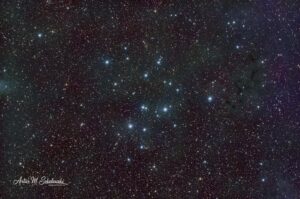
M39 star cluster
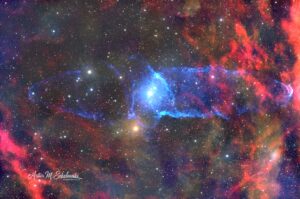
Sh2-129 Squid Nebula
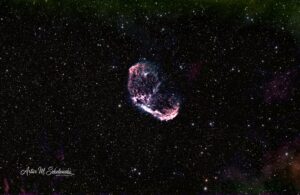
NGC 6888 Crescent Nebula