 NGC 7000, famously known as the North America Nebula (or Caldwell 20), is a massive interstellar cloud of ionised gas located approximately 2,590 light-years from Earth in the constellation Cygnus. It is one of the most prominent emission nebulae in the northern night sky, celebrated for its striking resemblance to the North American continent. Cosmic Composition & Structure
The nebula’s distinct shape is a mere cosmic coincidence. Intervening bands of dark, cold interstellar dust lanes block light from behind, acting like a stencil that carves out the shape of the Gulf of Mexico and the cosmic “coastal” borders.
Stretching more than 100 light-years across, the nebula covers an area in the night sky roughly 10 times larger than the full moon. Because its light is spread over such a vast area, it has low surface brightness and is not easily seen with the naked eye.
NGC 7000 is a dense H II region heavily filled with ionised hydrogen plasma. Gravitational collapse within these thick gas clouds feeds furious, ongoing star formation.
The nebula glows with a characteristic deep crimson-red hue. This occurs because intense ultraviolet radiation from hot, young O-type stars strips electrons from hydrogen atoms, which emit red “Hydrogen-alpha” light when they recombine.
This photograph was taken in July 2026 and consists of frames of red, green and blue equalised with the luminance frames.
The total exposure time is around 12 hours. The photo was taken in a Bortle 7 area (SQM around 18.8 mag/arcsec²).
Astrophotography made easy
More Stories
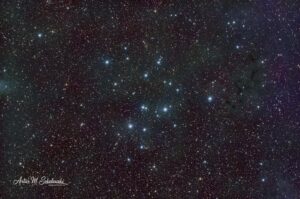
M39 star cluster
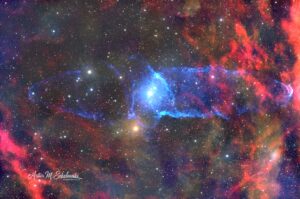
Sh2-129 Squid Nebula
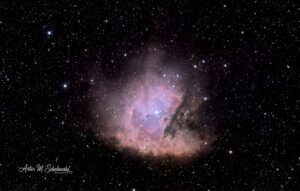
NGC281 Pacman