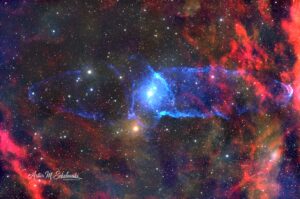
As I stated a year ago, I have returned to the Sh2-129, popularised as the Flying Bat Nebula. It is a vast and complex H II emission nebula located roughly 2,300 light-years from Earth in the constellation of Cepheus.
Last time I did the picture using a different refractor, a different camera, and I used a different set of tools (and skills). This picture shows the progress since then.
I probably mentioned that before: the overall Sh2-129 structure is visually massive, spanning roughly 3-4 degrees across our night sky. This means it occupies an area equivalent to 6 to 8 full moons side by side, yet remains completely invisible to the naked eye. The nebula’s main body consists of massive clouds of ionised hydrogen gas [Hα] that glow a deep, vibrant red. Its intricate, looping filament structures stretch across space, mimicking a gigantic bat with outstretched wings.
In May 2011, French amateur astrophotographer Nicolas Outters discovered the Squid Nebula from his backyard. He compiled 12.5 hours of deeply targeted Oxygen-III filtered data, revealing the hidden creature for the very first time.
The entire blueprint of the inner Squid Nebula is powered by a central system catalogued as HR 8119 (or HD 202214). Rather than a single star, this is a massive triple star system dominated by a hot, blue class-O giant star. The violent stellar winds and intense radiation from this trio blast material outward in opposite directions, creating the bipolar, squid-like gas streams.
While the nebula stretches a massive 50 light-years from tip to tip, its width across space is only about 8 light-years. Unlike most emission nebulae that are a chaotic mix of gases, the Squid is chemically unique. Its inner envelope is almost pure, doubly ionised oxygen gas ([O III]), making it look like a pristine blue glass sculpture suspended inside a red room of hydrogen.
Sh2-129 is widely considered one of the most difficult and punishing targets in the night sky to image. While the red “Bat” is moderately dim, the blue “Squid” inside is so exceptionally faint that photographers often have to expose their cameras for 30 to 50+ total hours from dark sky sites just to tease the blue oxygen silhouette out from the background.
The image I present is a result of acquiring light with 6 different filters: L, R, G, B, Ha and OIII. Because of my refractor’s relatively long focal length, the image doesn’t show the entire Flying Bat; instead, it focuses on the inner region containing the Squid Nebula itself, surrounded by ionised hydrogen clouds. The overall exposure time is 25 hours. The single OIII filter exposure took almost 9 hours. The whole session was held in the Bortle 7 area (SQM: 18.6 – 19 mag/arcsec²). It is definitely the most difficult and demanding image I have processed so far.
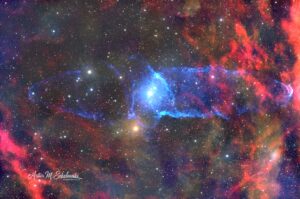
Last time I did the picture using a different refractor, a different camera, and I used a different set of tools (and skills). This picture shows the progress since then.
I probably mentioned that before: the overall Sh2-129 structure is visually massive, spanning roughly 3-4 degrees across our night sky. This means it occupies an area equivalent to 6 to 8 full moons side by side, yet remains completely invisible to the naked eye. The nebula’s main body consists of massive clouds of ionised hydrogen gas [Hα] that glow a deep, vibrant red. Its intricate, looping filament structures stretch across space, mimicking a gigantic bat with outstretched wings.
In May 2011, French amateur astrophotographer Nicolas Outters discovered the Squid Nebula from his backyard. He compiled 12.5 hours of deeply targeted Oxygen-III filtered data, revealing the hidden creature for the very first time.
The entire blueprint of the inner Squid Nebula is powered by a central system catalogued as HR 8119 (or HD 202214). Rather than a single star, this is a massive triple star system dominated by a hot, blue class-O giant star. The violent stellar winds and intense radiation from this trio blast material outward in opposite directions, creating the bipolar, squid-like gas streams.
While the nebula stretches a massive 50 light-years from tip to tip, its width across space is only about 8 light-years. Unlike most emission nebulae that are a chaotic mix of gases, the Squid is chemically unique. Its inner envelope is almost pure, doubly ionised oxygen gas ([O III]), making it look like a pristine blue glass sculpture suspended inside a red room of hydrogen.
Sh2-129 is widely considered one of the most difficult and punishing targets in the night sky to image. While the red “Bat” is moderately dim, the blue “Squid” inside is so exceptionally faint that photographers often have to expose their cameras for 30 to 50+ total hours from dark sky sites just to tease the blue oxygen silhouette out from the background.
The image I present is a result of acquiring light with 6 different filters: L, R, G, B, Ha and OIII. Because of my refractor’s relatively long focal length, the image doesn’t show the entire Flying Bat; instead, it focuses on the inner region containing the Squid Nebula itself, surrounded by ionised hydrogen clouds. The overall exposure time is 25 hours. The single OIII filter exposure took almost 9 hours. The whole session was held in the Bortle 7 area (SQM: 18.6 – 19 mag/arcsec²). It is definitely the most difficult and demanding image I have processed so far.
More Stories
M39 star cluster
NGC281 Pacman
NGC 6888 Crescent Nebula