 NGC 6992 is widely known as the Eastern Veil Nebula (or Caldwell 33). It is a massive, glowing cloud of heated, ionised gas and dust located roughly 2,400 to 3,000 light-years away from Earth. It sits within the northern constellation of Cygnus, the Swan.
This nebula is a supernova remnant. It forms the brightest visible section of the Cygnus Loop. The material was blasted into space when a massive star—roughly 20 times the mass of our Sun died in a supernova explosion. The stellar explosion occurred between 10,000 and 20,000 years ago. The debris cloud continues to expand outward, ploughing into the surrounding interstellar medium. This massive cosmic collision excites the gases, causing them to glow.
It earns the name “Veil” from its highly delicate, draped, and wispy filamentary structures. Unlike the distinct, sharp lines of other cosmic structures, NGC 6992 is composed of multiple, closely interwoven strands of gas. When captured using specialised narrow-band filters, the nebula splits beautifully into distinct colours. The long, rippling sheets display bright red hues from atomic hydrogen gas alongside vibrant blue-green shades from oxygen gas.
My picture was shot during a very short night, so it consists only of the RGB frames. Yet, when there is time (and sky), I plan to take additional frames using the O III and SII filters and integrate them into the picture.
More Stories
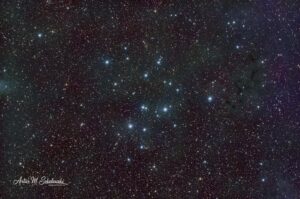
M39 star cluster
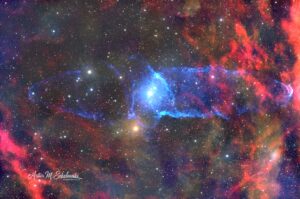
Sh2-129 Squid Nebula
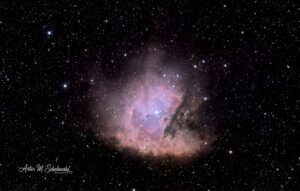
NGC281 Pacman