
Messier 63 (M63), famously known as the Sunflower Galaxy, is a spiral galaxy located approximately 27 to 37 million light-years away in the northern constellation Canes Venatici. It is named for its appearance. The arrangement of its many short, patchy spiral arms around a bright core closely resembles the central disk of a sunflower. Deep long-exposure photography has revealed faint tidal stellar streams in its outer halo, likely the remnants of a smaller satellite galaxy that M63 “devoured” in the distant past.
M63 is roughly the same size as our Milky Way, with a diameter of about 100,000 light-years and containing an estimated 400 billion stars. At its centre lies a supermassive black hole estimated to be up to 30 million times the mass of our Sun.
Pierre Méchain discovered M63 on June 14, 1779, and it was the very first discovery he contributed to his colleague Charles Messier’s famous catalogue. M63 has a visual magnitude of 8.6, making it a relatively bright target. While it appears as a faint, oval smudge in small telescopes, instruments of 8 inches or larger are typically required to begin resolving its distinctive spiral structure.
More Stories
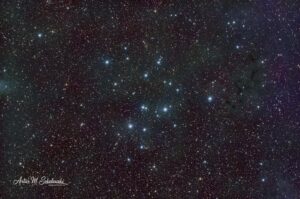
M39 star cluster
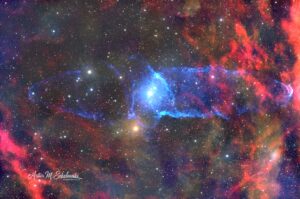
Sh2-129 Squid Nebula
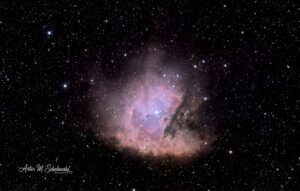
NGC281 Pacman