
The fundamental difference between a refractor and a reflector is how they collect and focus light: a refractor telescope uses glass lenses to bend light, while a reflector telescope uses curved mirrors to bounce light.
Your choice between a refractor and a reflector depends entirely on how you plan to use it, your budget, and how much setup work you are willing to do.
First, you have to understand the difference between those two main groups. So, let’s start with the basics…
Refractors
Refractor telescopes are built around lenses.
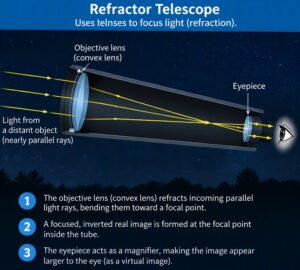 They look like the classic, traditional spyglass telescope. Light enters through a large objective lens at the front, travels straight down the tube, and hits the eyepiece at the rear. They are incredibly rugged and practically maintenance-free because the tube is completely sealed. They offer amazing, high-contrast, sharp views because nothing blocks the light path inside the tube. Yet, the large glass lenses are highly complex and expensive to manufacture flawlessly. As a result, large-aperture refractors become prohibitively expensive and quite heavy (which becomes particularly noticeable when mounting the telescope on a tracker). Cheaper refractors can also suffer from “chromatic aberration” (a purple or rainbow colour fringing around bright objects). This brings us to the next question: what are achromatic and apochromatic telescopes?
The difference between an apochromatic (APO) refractor and an achromatic refractor comes down to how many wavelengths (colours) of light the lenses can focus onto the exact same point, which dictates how much “false colour” or colour fringing you will see in the image.
When white light passes through a glass lens, it bends like a prism and splits into its component colours (red, green, and blue). Because they bend at different angles, they naturally want to focus at slightly different distances, causing chromatic aberration (a distracting purple or rainbow halo around bright objects like planets, stars, or the Moon).
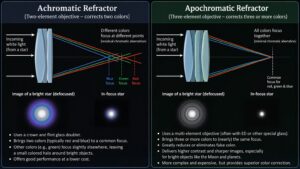
An achromatic is the traditional, economical refractor. It pairs two different types of glass lenses to correct the light path. If you’re serious about photography, don’t use it as your main telescope. It will be difficult to achieve valuable results, and processing images acquired with achromats is much harder. Yet we use the achromatic refractors in our setups as the guide scopes. Please let me know in the comments if you want me to write a separate article about guide scopes and guiding.
APO refractors are popular among astrophotographers because they greatly reduce chromatic aberration and produce sharp, high-contrast images. They add a third (and sometimes fourth or fifth) lens layer, using expensive, specialised ED (Extra-low Dispersion) glass or synthetic fluorite crystals. This complex combination successfully bends all three primary colours of light to the exact same focal point. The result is typically tighter stars, very little colour fringing, and excellent contrast compared to an achromatic refractor.
Reflectors
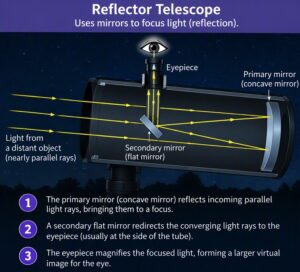 Invented by Sir Isaac Newton to bypass the colour distortion of glass lenses, reflectors use a curved primary mirror at the back of the tube. Light travels down the open tube, hits this mirror, bounces up to a small, angled secondary mirror near the front, and is directed out the side to the eyepiece.
Mirrors are significantly cheaper to make than lenses. This means you can buy a massive “light bucket” reflector (like a Dobsonian) for a fraction of the cost of a large refractor, allowing you to see faint deep-sky objects like distant galaxies and nebulae. Reflectors also have no chromatic aberration.
Because the tube is open to the elements, the mirrors gather dust and moisture. The mirrors can shift during transport, so you’ll need to align them regularly (a quick calibration process called collimation). The small secondary mirror also blocks a tiny bit of incoming light, slightly lowering the crispness and contrast compared to an equal-sized refractor.
While telescope “models” usually refer to commercial product lines, reflector types refer to distinct optical designs (the arrangement and shapes of the internal mirrors).
Reflector types differ in how they direct light through the optical system and how they correct optical aberrations. Here are the basic types.
Newtonian Reflectors
The Newtonian is the most common, traditional type of reflector telescope.
Light enters the open tube, reflects off a curved (parabolic) primary mirror at the bottom, bounces off a flat, diagonal secondary mirror near the top, and exits the side of the tube into the eyepiece.
The Standard Newtonian is mounted on traditional tripods (e.g., Sky-Watcher Starquest DX130P).
A Dobsonian is a Newtonian tube sitting on a heavy, rotating floor-box mount (e.g., StellaLyra 8″ f/6 Dobsonian). It offers the absolute best visual value per pound spent. But remember: visual value will not bring you closer to the photography.
Pure Cassegrain Reflectors
Cassegrains “fold” the light path, packing an incredibly long focal length into a short, highly portable tube.
Light travels down the tube, hits a concave primary mirror, and bounces back up to a convex secondary mirror in the centre. The secondary mirror shoots the light straight back down through a physical hole in the centre of the primary mirror, exiting out the back of the telescope where you attach your eyepiece.
These use strictly curved mirrors with zero corrector lenses. They are prized for planetary viewing because their long focal lengths easily achieve high magnification.
Ritchey-Chrétien (RC) Reflectors
The Ritchey-Chrétien is a highly specialised variant of the Cassegrain design engineered explicitly for deep-space astrophotography.
• The Layout: Mechanically identical to a Cassegrain (light exits through a hole in the back), but it replaces the standard mirrors with complex, precisely shaped hyperbolic primary and secondary mirrors.
• Characteristics: This layout eliminates an optical distortion called coma (which makes stars at the edge of an image look like little comets). It also provides excellent star shapes across a large imaging field, although many astrophotographers still use a field flattener or reducer for larger sensors (like full-frame).
Many professional observatories, including the Hubble Space Telescope, use Ritchey-Chrétien optical designs.
Catadioptric Reflectors (Compound/Hybrid)
While technical purists consider these a separate hybrid class, they are fundamentally reflectors that use a thin glass corrector lens at the front opening to fix optical aberrations before the light hits the main mirrors.
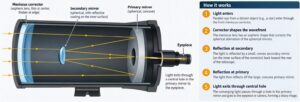 • Schmidt-Cassegrain (SCT): Uses a thin, specially figured Schmidt corrector plate at the front. It is one of the most popular all-purpose designs for both visual viewing and planetary imaging.
• Maksutov-Cassegrain (Mak): Replaces the front plate with a thick, heavily curved spherical corrector lens (meniscus lens). Designs like the Sky-Watcher StarQuest 102MC offer incredibly sharp, high-contrast views of the Moon and planets in a tiny footprint.
Choose a Refractor If…
• You want a “grab-and-go” telescope. You can pick it up, take it outside, and start viewing with minimal cool-down time or optical adjustments.
• You hate maintenance: The sealed tube means it will never require alignment (collimation) or internal dust cleaning.
• You want to look at the Moon and planets: The lack of central obstructions inside the tube gives you the highest possible contrast for planetary details and split double stars.
• If you plan some serious deep space imaging, especially using the larger camera sensors and narrow-band filters, consider the refractor with more than 3 lenses (APO quad or even quintuplet). 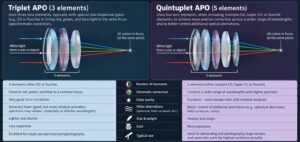
After using APO refractors, 3-, 4-, and 5-lens designs over the years, I still find that a small APO refractor is usually the quickest and least frustrating way to start an imaging session. It lets you get good results with the least effort, and smaller setups forgive the errors every beginner makes (including me).
Choose a Reflector If…
• You want the most performance for your money: You can buy a massive 8-inch reflector (like a Dobsonian) for the same price as a tiny, premium 3-inch refractor.
• You want to see faint, deep-space objects: Faint targets like nebulae, distant galaxies, and star clusters require large diameters to collect light, which only reflectors can provide affordably.
• You don’t mind basic maintenance: You are comfortable spending a few minutes aligning the internal mirrors (collimating) before a viewing session.
• You have a dark sky or can travel to one: Because reflectors excel at dim deep-sky objects, they truly shine when you can take their larger frames out to a dark location away from city lights.

More Stories
What is PSF – Point Spread Function?
Dithering – is it really important?
NGC 7380 The Wizard Nebula