 IC 5070, popularly known as the Pelican Nebula, is a large and highly active emission nebula located in the constellation Cygnus (The Swan). It is a classic example of an H II region—a massive cloud of partially ionised gas where vigorous star formation is actively occurring.
It is not an isolated structure. It is actually part of the same massive interstellar cloud as its famous neighbour, NGC 7000 (the North America Nebula). The two are visually separated from our perspective by a dense, dark lane of foreground cosmic dust known as a molecular cloud.
The nebula gets its name from its striking resemblance to a pelican. The cosmic dust and glowing gas trace out a bird-like silhouette, featuring a distinct eye, a long, curved neck, and a large beak. The nebula is highly dynamic. Ultraviolet radiation bleeding from massive, hot, newly formed stars just outside the frame is heating the cold gas. This creates a high-pressure boundary layer called an ionisation front, which is gradually carving out and reshaping the nebula’s dense edges.
Deep within the “neck” and “body” of the Pelican, dense columns of cold gas (often called elephant trunks or molecular pillars) are fighting back against the destructive stellar winds. Embedded inside these dark dust pillars are infant protostars. One famous region contains Herbig-Haro object 555 (HH 555), where a hidden newborn star is blasting powerful, narrow jets of gas outward at hundreds of kilometres per second.
Essential ProfileType:
- Emission Nebula / H II Region
- Distance from Earth: Approximately 1,800 to 2,000 light-years
- Apparent Magnitude: ~8.0 (Invisible to the naked eye, but an excellent target for binoculars or small telescopes under dark skies)
- Real Dimensions: Spans roughly 30 light-years across
- Apparent Size: 60 × 50 arcminutes (nearly twice the size of the full moon in the night sky)
Because IC 5070 glows intensely in the Hydrogen-alpha wavelength, it is a favourite playground for amateur and professional astrophotographers alike. Photographers frequently use narrowband filters—isolating Hydrogen, Sulfur, and Oxygen—to bypass city light pollution and reveal the intricate, chaotic layers of gas and dust that make up the Pelican’s silhouette.
More Stories
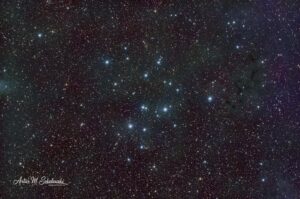
M39 star cluster
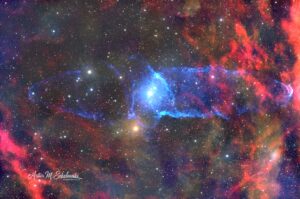
Sh2-129 Squid Nebula
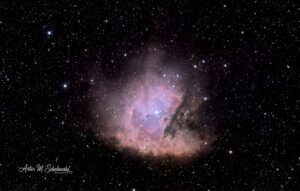
NGC281 Pacman