 Barnard 150 (Ba-150), popularly known as the Seahorse Nebula, is a dark nebula located in the northern constellation of Cepheus. It is a dense, cold molecular cloud of dust and gas that absorbs visible light from the stars behind it, creating a striking silhouette against the rich, starry background of the Milky Way.
It is located approximately 1200 – 1400 ly from Earth and has a size of 15-20 ly across. It was catalogued by the American astronomer E.E. Barnard in 1919 as one of 182 dark markings in the sky.
The designation Ba 150 is sometimes listed under LDN 1082 (the same object is also present in another catalogue). Deep inside the cloud, astronomers have identified three particularly dense cores—LDN 1082 A, B, and C. These cores are “star-forming fibres” where cold gas and dust are collapsing under gravity to form Class 0 protostars (the earliest stage of star birth), which are currently only visible via long-wavelength infrared light.
Research indicates that the magnetic fields within the core L1082C are remarkably uniform, suggesting that magnetism plays a crucial role in preventing the cloud from collapsing too quickly and helping it maintain its filamentary shape. As light from background stars passes through the outer edges of B150, the dust scatters shorter (blue) wavelengths, causing the stars to appear significantly redder than they actually are.
More Stories
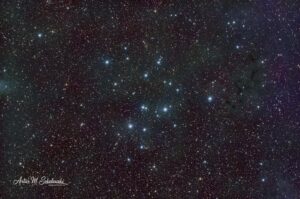
M39 star cluster
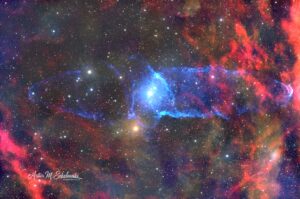
Sh2-129 Squid Nebula
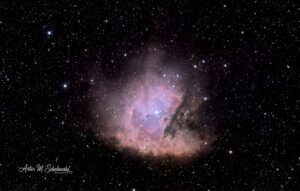
NGC281 Pacman