
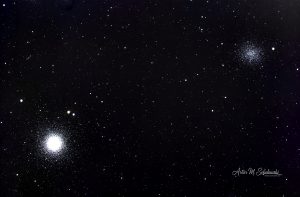
The image shows two globular clusters: M53, the bright and densely populated cluster in the lower left, and NGC 5053, visible as a much fainter haze on the right.
NGC 5053 lies just over 53,000 light-years from Earth and about 58,000 light-years from the centre of the Milky Way. It is an exceptionally faint and loosely populated globular cluster, containing only around 3,500 stars. Despite their very different appearances, NGC 5053 and M53 are close neighbours in the sky, separated by only about 1°.
M53 is much more impressive, containing roughly 500,000 stars. It lies around 58,000 light-years from Earth and has a diameter of about 220 light-years. At more than 12.5 billion years old, it is one of the ancient globular clusters whose stars formed during the early history of our galaxy.
Interestingly, M53 may not have originated in the Milky Way at all. One theory suggests our galaxy captured it and that it may be associated with material from the Sagittarius Dwarf Galaxy.
Together, M53 and NGC 5053 make an interesting pair. Although they appear relatively close in the image, their enormous difference in brightness and stellar density makes the contrast between the two globular clusters particularly striking.

More Stories
M 33 The Triangulum Galaxy
NGC 7380 The Wizard Nebula
M39 star cluster