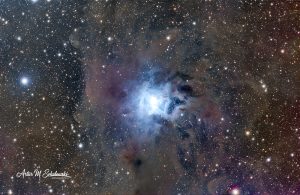
 NGC 7023, famously known as the Iris Nebula, is a stunning reflection nebula located approximately 1,300 light-years away in the northern constellation of Cepheus. It is a popular target for astronomers and photographers alike because of its vivid blue colour and unique flower-like shape.
It is a reflection nebula, meaning it doesn’t emit its own light but instead reflects the light of a nearby star. It is lit by a hot, young, massive star at its centre, named HD 200775.
It spans about 6 light-years across and shines at an apparent magnitude of 6.8, making it relatively bright for its type.
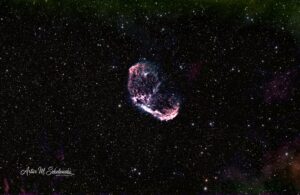
As you can see in the photograph, the dominant blue hue comes from starlight scattering off fine dust particles, similar to how Earth’s atmosphere scatters sunlight.
Some central filaments glow with a faint reddish photoluminescence, thought to be caused by complex hydrocarbon molecules.
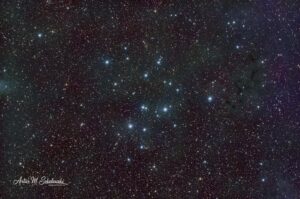
The designation “NGC 7023” technically refers to the open star cluster located within the larger nebulosity, which is sometimes catalogued separately as LBN 487. The nebula is surrounded by vast, dark clouds of interstellar dust that block background starlight, creating a dramatic high-contrast effect. If you open the picture beside, you can see this.
The nebula was discovered by astronomer William Herschel on 18 October 1794. While it has a magnitude of 6.8, its diffuse nature makes it difficult to see with small binoculars. A telescope of at least 10 inches is typically recommended to see intricate details. My observation was made using the quad apochromatic refractor with an aperture of 130mm, but the total integration time was almost 8 hours.
Astrophotography made easy
1 thought on “NGC 7023 Iris Nebula”