The Galaxy M 106 (also known as NGC 4258) is located approximately 22 to 25 million light-years from Earth.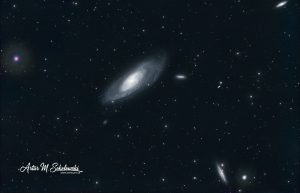 It is an intermediate spiral galaxy. Its diameter is about 135,000 light-years—slightly larger than the Milky Way and comparable to the Andromeda Galaxy. It is estimated to contain about 400 billion stars. It is a Seyfert II galaxy with an extremely active core powered by a central supermassive black hole (with a mass of about 39 million solar masses).
Unlike the two normal spiral arms composed of stars, M106 has two additional arms made of hot gas. These are thought to be formed by energetic jets from the central black hole falling into the galaxy’s disk. M106 is famous for hosting a water-vapour megamaser, a natural microwave laser, which allows astronomers to measure the galaxy’s distance with incredible precision. M106 is the largest member of the Canes II Group (or CVn II Group), a loose cluster of galaxies in the constellation Canes Venatici.
The main companions are NGC 4248: a small and irregular galaxy located very close to M106. It is a confirmed satellite and may be interacting gravitationally with it; NGC 4217: a prominent edge-on spiral galaxy, often seen in wider views of M106. Although it appears close, it is much further away—about 60 million light-years away. Recent radio observations have revealed a massive hydrogen signature extending over 400,000 light-years between M106 and another possible satellite, NGC 4288.
Many of the stars in the foreground are actually members of our own Milky Way Galaxy, millions of times closer than M106 itself.
Please, visit the Deep Sky Gallery to see more objects.
More Stories
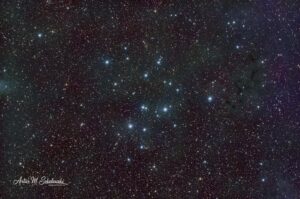
M39 star cluster
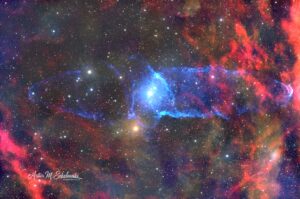
Sh2-129 Squid Nebula
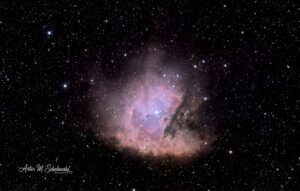
NGC281 Pacman