Astrophotography is the photography or imaging of astronomical objects, celestial events, or specific areas of the night sky.
It is a unique discipline within photography because the subjects—like distant galaxies, nebulae, or even faint stars—are often extremely dim and require specialised techniques to capture.
The core goal of astrophotography is to accumulate light photons over long periods, allowing cameras to “see” colours and details that are completely invisible to the unaided human eye.
The subject matter in astrophotography can be divided into a few main categories, which often dictate the equipment and exposure techniques required:
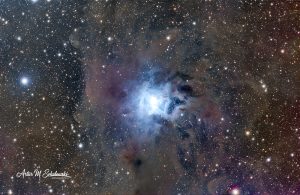
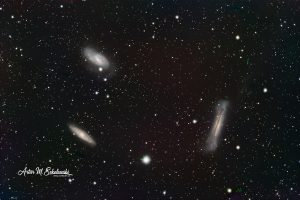
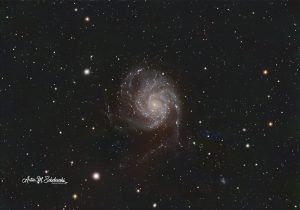
- Deep-Sky Objects (DSOs): These are extremely faint objects outside our solar system, such as galaxies (e.g., Andromeda), nebulae (e.g., Orion), and star clusters. Capturing these typically requires a telescope, an equatorial (tracking) mount to counteract the Earth’s rotation, and very long exposure times.
- Planetary & Lunar Imaging: Photographing the Moon and bright planets (such as Jupiter or Saturn) is relatively straightforward. These subjects are very bright, so they can often be captured by holding a smartphone up to a telescope eyepiece or using a camera for high-magnification, short exposures (often multiple video frames are captured and “stacked”).
- Wide-Field & Nightscape Imaging: This involves capturing large sections of the night sky, often including the Milky Way or constellations, with a terrestrial foreground (e.g., mountains, trees). This can often be done with just a DSLR/Mirrorless camera and a sturdy tripod, or a simple star tracker.
- Star Trails: These images capture the apparent motion of stars across the sky caused by Earth’s rotation, creating beautiful concentric arcs. This is achieved by combining multiple long exposures or taking a single, extremely long exposure.
An IT network engineer by profession. A passionate diver. Active diving instructor and EFR (Emergency First Response & Secondary Care) instructor. Technical diver TDI Advanced Trimix Open Circuit and X-CCR Normoxic Trimix. Closed-circuit diving enthusiast. Yet also an astrophotographer. After all these years, I'm still a beginner, learning the stuff to do things better.