
The Bortle scale is a system created by John Bortle to measure and categorise sky darkness. He is an amateur astronomer, best known for developing a scale to assess or quantify darkness. Still, he is also known for studying variable stars and for creating predictive models to estimate the probability that the comet would survive perihelion.
His Darkness Scale was published in 2001 in Sky and Telescope magazine. The scale ranges from 1, indicating an extremely dark rural area (likely highly elevated) with low humidity and mostly no wind, to 9, indicating the inner city with a high number of streetlights, urban infrastructure, and elevated air pollution.
Levels 1 – 3 indicate the most desirable places, free from external light, allowing one to see the sky with many stars, including faint ones, such as dark nebulae or distant star clusters.
Levels 4 – 6 are usually suburban or rural areas where light pollution can affect the horizon, making faint objects difficult to spot but still available for photography when you use filters.
Levels 7 – 9 mean the sky is filled with artificial light, making it difficult to spot even the brighter stars or celestial objects.
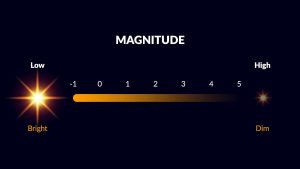
Each level corresponds to a value called the magnitude, which indicates the object’s brightness. I will try to describe this parameter later, in a separate article.
The purpose of creating such a scale is to help astronomers, astrophotographers, or just stargazers know the quality of the location they plan to use. It also allows the comparison of different sites.
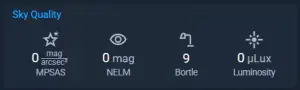 Summarising, the Bortle scale allows a simple way to show and understand the sky quality at a given location at a given time. Several devices can measure and produce sky-quality output, which can eventually be used as a variable during your photography session.
The example shown here indicates the Bortle 9 because the measurement was taken during a day. Usually, in my area, the Bortle ranges from 6 to 7, which are not ideal conditions but still allow for fun with this hobby and quite good pictures.
1 thought on “What is Bortle?”