NGC 4565, commonly known as the Needle Galaxy, is one of the most striking spiral galaxies in the sky, seen almost exactly edge-on. This orientation makes it a model of what a galaxy like our Milky Way might look like from the side.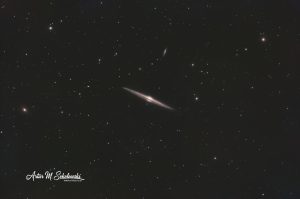 It was catalogued by William Herschel in 1785.
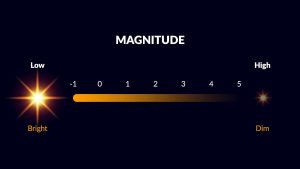
Located in the constellation Coma Berenices, near the north galactic pole, it is estimated to be about 30–50 million light-years from Earth and has a diameter of about 100,000 light-years, making it similar in size to the Milky Way. Its visual magnitude is around 9.6–10, making it easily accessible to amateur telescopes.
The Needle is an extremely slender galaxy. Its length-to-width ratio is about 8:1. A distinct, dark dust lane runs along the entire length of the disk, intersecting the bright central nucleus. The galaxy’s nucleus is quite distinctive. It is yellowish and protrudes above the disk plane. Spitzer Space Telescope observations suggest it is a barred spiral galaxy.
NGC 4565 hosts a system of about 240 globular clusters, more than the Milky Way.
When to observe? The best conditions are in spring (March–May). In small telescopes (less than 300 mm), it appears as a long, narrow haze. In instruments with a focal length of 400 mm or larger, the dark dust lane intersecting the nucleus is easily visible under dark skies.
Astrophotography made easy
More Stories
NGC 7023 Iris Nebula
NGC3628 and the Leo Triplet
M 101 Pinwheel Galaxy