M 31, commonly known as the Andromeda Galaxy, is the closest large spiral galaxy to the Milky Way, located in the constellation Andromeda. It is the most distant object in space that can be seen with the naked eye under favourable conditions.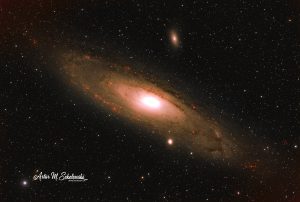
It is located about 2.5 million light-years from Earth. Its diameter is approximately 220,000–260,000 light-years, making it significantly larger than our galaxy.
It is estimated to contain about 1 trillion stars, more than twice the mass of the Milky Way.
M 31’s mass is similar to that of the Milky Way, although more recent studies suggest it may be slightly lighter due to a smaller amount of dark matter.
M 31 is a barred spiral galaxy (type SA(s)b). At its centre lies a supermassive black hole with a mass of about 140 million Suns. Interestingly, M31’s core exhibits a “double” structure: an elliptical ring of ancient red stars. The galaxy has numerous satellites, the brightest of which are the elliptical galaxies M32 and M110 (NGC 205).
The object was first described as a “small cloud” by the Persian astronomer Abd al-Rahman al-Sufi in 964 AD. However, it wasn’t until the 1920s that Edwin Hubble proved that it was not a nebula within our galaxy, but a separate, then-called “island universe.”
A collision with the Milky Way seems to be inevitable. M31 is approaching us at a speed of about 400,000 km/h. This means that in about 4 billion years, the two galaxies will collide, ultimately forming a single giant elliptical galaxy.
The best time to observe Andromeda is in autumn (especially in November).
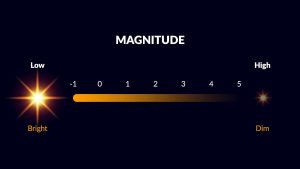
To the naked eye, M31 appears as a faint, elongated patch of light with a brightness of about 3.4 magnitude. In binoculars or a telescope, you can see the bright nucleus and darker dust lanes in its arms.
For images, it’s best to use a telescope with a moderate focal length (400mm or less, depending on the camera resolution). If the images are taken with a monochrome camera, it’s worth sacrificing some time to capture H-alpha-filtered frames in addition to RGB frames, given the significant emission in the ionised-hydrogen band.
More Stories
NGC 7023 Iris Nebula
NGC3628 and the Leo Triplet
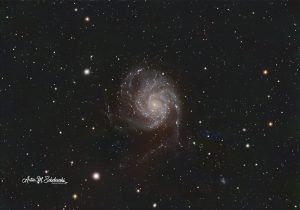
M 101 Pinwheel Galaxy