The Pinwheel Galaxy, formally known as Messier 101 (M101), is a massive grand-design spiral galaxy located approximately 21 to 25 million light-years away from Earth in the constellation Ursa Major.
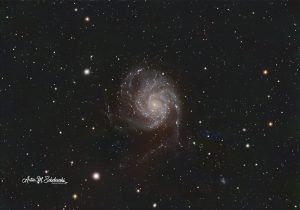 It is a giant compared to the Milky Way, spanning about 170,000 to 252,000 light-years in diameter. This makes it nearly twice the size of our own galaxy.
Scientists estimate that M101 contains roughly one trillion stars, about five times the number found in the Milky Way.
Because we see it from a “face-on” perspective, its elegant spiral structure is fully visible, resembling a giant cosmic pinwheel.
Unlike many spiral galaxies, M101 is notably lopsided. This asymmetry is caused by tidal forces from gravitational interactions with its smaller companion galaxies, which pull on its outer arms.
Its arms are filled with H II regions—intense regions of star formation where massive, hot, blue stars are born. Over 1,200 of these regions have been catalogued, and some are so large they have their own NGC designations. In May 2023, a bright Type II supernova named SN 2023ixf was discovered in one of its spiral arms. It was one of the closest and brightest supernovae seen in recent years, making M101 a major point of interest for both professional and amateur astronomers.
M101 was discovered by Pierre Méchain in 1781 and subsequently verified by Charles Messier for his famous catalogue. It has relatively low surface brightness, making it difficult to see with the naked eye even in dark skies; however, it is a popular target for astrophotographers using even small telescopes.
More Stories
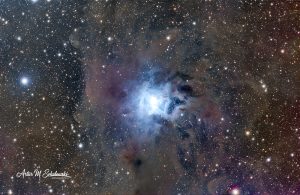
NGC 7023 Iris Nebula
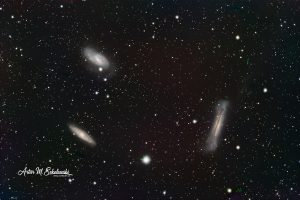
NGC3628 and the Leo Triplet
NGC 4565 – Needle Galaxy