What is magnitude, and how to interpret the value? To answer this question, first, we have to touch on another term – the logarithm.

Simply put, a logarithm is the inverse of an exponent. It answers the question: “To what power must we raise a base number to get a specific value?”
For example, if you know that 10^2 = 100, then the logarithm (base 10) of 100 is 2.
The notation:
log [base b] (n) = x
means
b^x = n
where:
b – is the base of the logarithm (the number being multiplied)
x – is the exponent (the result of the logarithm)
n – is the value you want to reach
Logarithms are incredibly useful for turning multiplication into addition and for measuring things that grow or shrink exponentially, like sound (decibels), earthquakes (Richter scale), pH levels in chemistry or… astronomy to measure the object brightness.
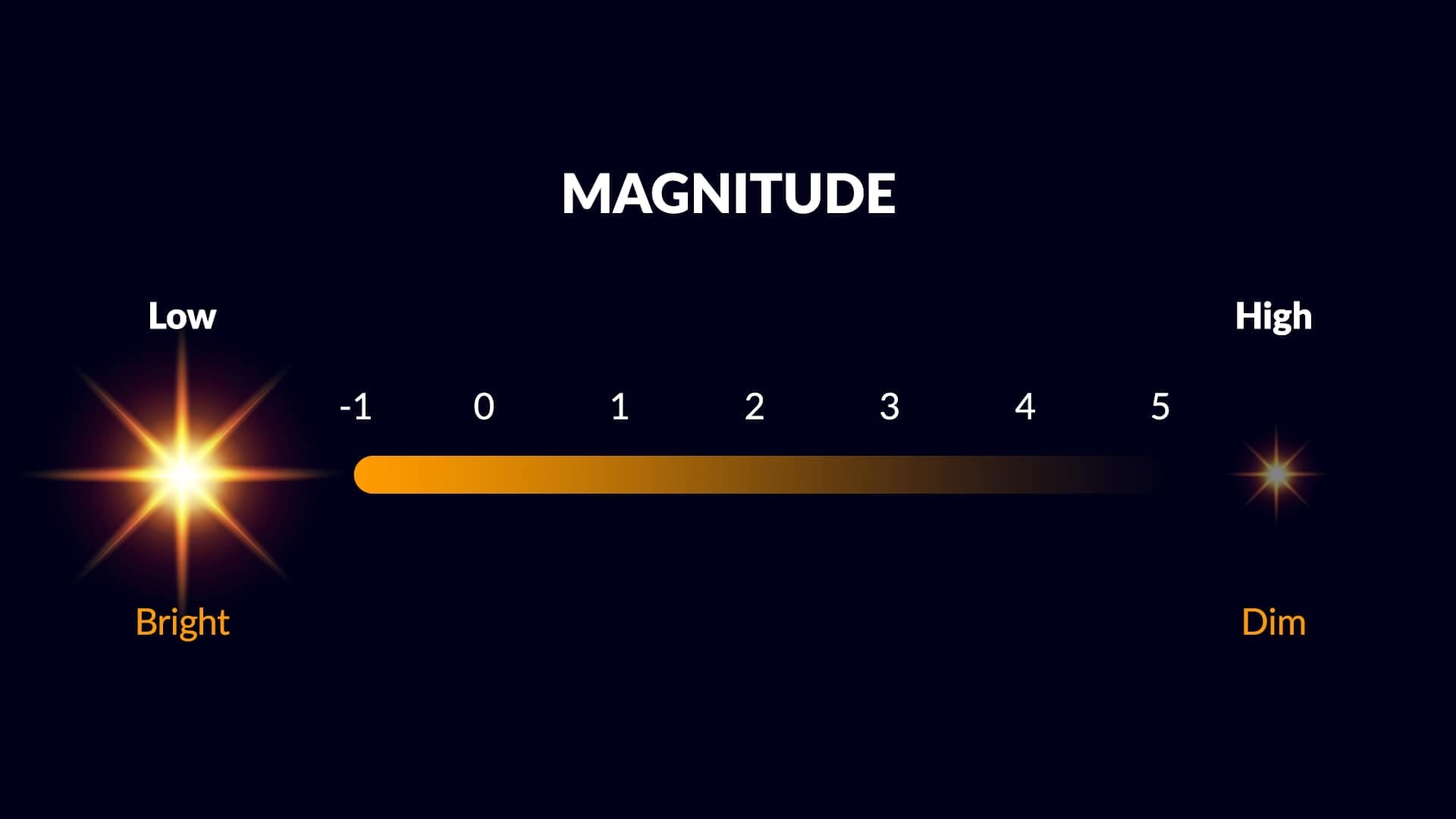
In astronomy, magnitude is a logarithmic measure of the brightness of a celestial object. The scale is “backwards”—meaning a smaller or more negative number represents a brighter object.
So, the Magnitude… several terms sound very similar, but in fact, each has a different meaning.
Apparent Magnitude
This is how bright an object appears to an observer on Earth. It depends on the object’s actual light output, its distance from us, and any dust that might be blocking the light.
A difference of 5 magnitudes equals exactly a 100-fold difference in brightness.
Here are a few examples:
- Sun: -26.7 (extremely bright)
- Full Moon: -12.7
- Sirius: -1.46 (the brightest star in the night sky).
- Human Eye Limit: Approximately +6 to +6.5 (in the dark skies)
Absolute Magnitude
This is a measure of an object’s intrinsic brightness (luminosity). It is defined as the apparent magnitude an object would have if it were placed at a standard distance of 10 parsecs (about 32.6 light-years). It allows astronomers to compare the actual power of stars regardless of how far away they are.
Example: While the Sun’s apparent magnitude is -26,7, its absolute magnitude is only +4,83. If the Sun is 10 parsecs away, it would look like a faint star, barely visible from a city (Bortle 9)
Surface Brightness (relevant to Nebula)
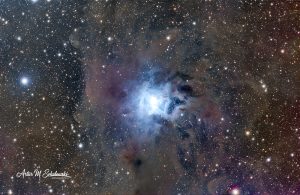
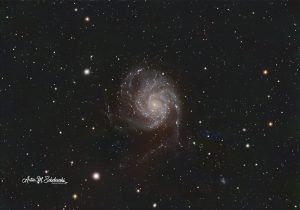
For diffuse objects like the Iris Nebula (shown in a picture beside), magnitude can be tricky. While a nebula might have a “total magnitude” of 6.8, that light is spread out over a large area. This makes it look much fainter than a single star of the same magnitude.
Quick Reference Scale
- Highly Negative (-27 to -12): Extremely bright objects like the Sun and the Full Moon.
- Zero (0): Traditionally defined by the star Vega, a reference point for brightness.
- Positive (1 to 6): Stars visible to the naked eye. Magnitude 6 is the general limit for human vision in very dark skies.
- High Positive (7+): Dim objects that require binoculars or telescopes to see.
Conclusion
Beyond the basic “bright vs. dim” scale, there are three concepts that are critical for actually understanding what you see in the sky:
The Logarithmic Nature (The “Rule of 2.5”)
The scale isn’t linear. A magnitude 1 star isn’t twice as bright as a magnitude 2 star; it is 2.512 times brighter.
This means a difference of 5 magnitudes (e.g., from mag 1 to mag 6) is exactly a 100 times change in brightness.
A difference of 10 magnitudes is a 10,000 times change in brightness.
Integrated Magnitude vs. Surface Brightness
This is the most common “trap” for beginners.
Integrated (Total) Magnitude: The total light of an object if you “squished” it into a single point like a star.
Surface Brightness: How spread out that light is.
Why it matters: A galaxy might have a “bright” magnitude of 8.0, but because that light is spread over a large area, it looks like a faint gray smudge. A star of magnitude 8.0 will look much “brighter” and sharper because all the light is in one tiny point.
Filters and Colour (Bolometric vs. Visual)
Objects have different magnitudes depending on the “colour” of light you measure.
Visual Magnitude (V): What the human eye sees (mostly green/yellow light).
Bolometric Magnitude: The total energy output across all wavelengths (X-rays, UV, Infrared, etc.).
Importance: A very cool, red star might look faint to your eyes (Visual), but be incredibly powerful in the Infrared spectrum.
Extinction (Atmospheric Dimming)
The air itself “steals” magnitude.
When an object is low on the horizon, its light passes through more atmosphere, making it dimmer than when it is directly overhead.
Space dust (interstellar extinction) also dims distant objects, making them appear lower magnitude than they actually are.
More Stories
What is Bortle?
What is harmonic mount
Exposure time – how long is too long – Part 1